
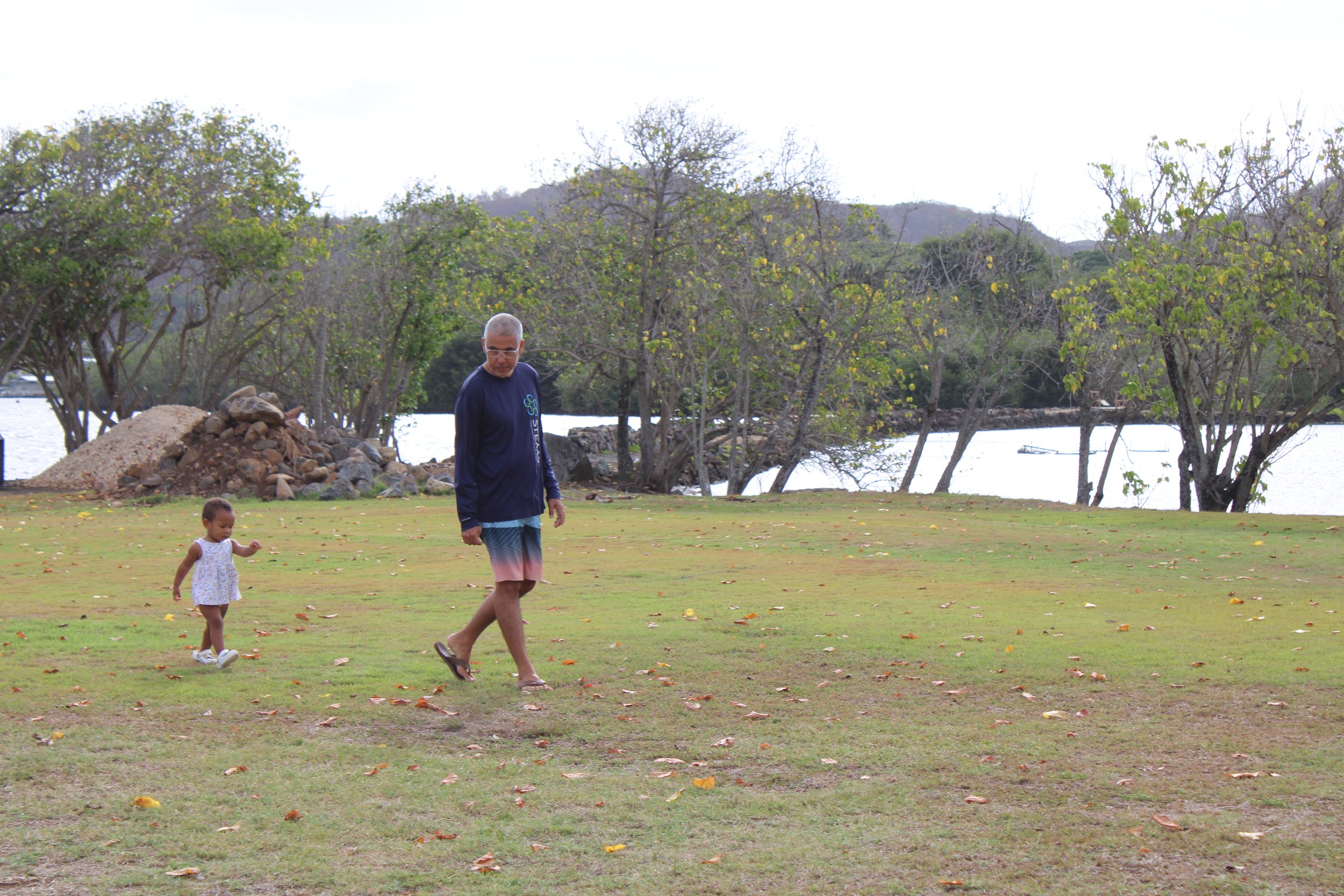
Pacific American Foundation CEO Kapono Ciotti walks along Waikalua Loko Iʻa with his daughter. Photo credit: Grace Cajski
We live in a moment that asks a profound question of each of us: What kind of ancestor will you become?
The Next 200 is a movement rooted in that question and in the ancient wisdom that has always guided us here in Hawaiʻi.
To understand what we mean by the Next 200, we turn to the Hawaiian word moʻokūʻauhau, often translated as “genealogy.” But genealogy, in the Western sense, is a flat word. It connotes diagrams of names arranged in neat rows moving in one direction. Moʻokūʻauhau is something far more alive and multidimensional. It is the story of who we are, carried in the bodies of our kūpuna and passed forward through our actions and, in time, our descendants. Moʻokūʻauhau is legacy as living practice. It is the story of your family carrying inherited knowledge forward into every new generation. The Next 200 is a way of moving through time.
The ʻōlelo noʻeau, the Hawaiian proverb, I ka wā ma mua, i ka wā ma hope, illuminates this beautifully. Translated, it means “In the time before, in the time after.” The deeper teaching is that the future is in the past. We navigate forward by looking back, drawing on the lessons, courage, and wisdom of those who came before us. We move through time as navigators, looking to the stars our ancestors charted, the currents they memorized, the winds they named, to move into waters we have never sailed before. We are becoming the ancestors that those behind us will one day look to for direction. The Next 200 is an agreement to be good ancestors: to walk purposefully, to act with courage, and to tend the world in ways that will make our descendants proud.
The Next 200 is named for the next two hundred years. Not because we can predict what those years will hold, but because we choose to be accountable to them. We choose to ask the hard question now, while we still have time to act: What can we do for those who come after us? It is a simple and sacred question. The Next 200 is a perspective, one that looks at extremely long time horizons: to seven generations and beyond.
Pacific American Foundation and the Next 200
Since 1993, the Pacific American Foundation has championed programs, projects, and initiatives founded upon the belief that education is the most profound act of social justice. When we transform how young people learn, we transform the world they will come to build.
PAF holds the space and tends the earth for the Next 200 movement. We are the soil in which this movement grows. With over three decades of impact across Hawaiʻi and beyond, we have touched the lives of tens of thousands of students and teachers through culturally rooted curriculum, place-based education, professional development, and the living classroom of Waikalua Loko Iʻa. Now, as PAF moves into its fourth decade, the Next 200 helps us tell that story in a new way, not just to those who know PAF, but to anyone who has ever asked whether their actions today matter to someone they will never meet.
The Next 200 is the movement that lives inside the work PAF does every day, the pilina, the deep connections we build between people, systems, ʻāina, and ideas. It is how we communicate our story to those who may not yet know PAF’s name but who share our deepest value: that the decisions we make today echo far beyond our own lifetimes. The Next 200 bridges the profound and the practical. It is both vision and invitation.
Why We Must Act Now
If you have ever stood at the edge of Waikalua Loko Iʻa, you understand urgency in a way that no report or policy paper can teach you.
We see the impact of climate change at Waikalua Loko Iʻa in real time, with our own eyes. The sea levels are rising. The erosion is visible. The flooding comes more often. The runoff carries the wounds of the uplands into the waters of our beloved fishpond. Invasive species, from mangrove to seaweed to marine debris, push against every effort to restore what was once a thriving loko kuapā, built by our kūpuna centuries ago.
We have kuleana, a responsibility, as the younger sibling to this fishpond. In Hawaiian tradition, kuleana is not just obligation. It is a sacred relationship between a person and the thing they are called to care for. Waikalua Loko Iʻa has taught us that the only time to take action is now. Not next year. Not after the next study. Now. The lessons of the past three decades are clearer than ever: the world does not wait for us to be ready. The fish do not wait. The water does not wait. Our keiki do not wait.
And neither should we.
We have learned too much and loved too much to stand still. The lessons from yesterday, the decisions of today, and the world our descendants inherit are not separate things. They are the same river, moving in the same direction. When we tend the fishpond, we are tending the future. When we train a teacher, we are planting seeds that will bloom long after we are gone. When we take decisive, courageous action now, even when it is hard and especially when it is hard, we are becoming the ancestors we were always meant to be.
What We Look Forward To
In 2026 and in the years ahead, the Next 200 is about one thing above all else: uplifting stories of becoming good ancestors.
Every person who tends a garden, mentors a child, restores a fishpond, writes a curriculum, or shows up for their community is living the Next 200. Every teacher who changes the way they see a student. Every family that passes down a mele, a language, a value. Every leader who supports, protects, uplifts. These are the stories we need to celebrate together and the inspiration we need to share with one another.
The Next 200 is a celebration of all of us who are trying. We do not need to be perfect ancestors; we merely need to be good ones: present ones, ones who show up with intention, who learn from the past, and who act in service of a future far beyond their own lifetimes.
In 2026, we are launching this movement as an invitation, not just to PAF’s community, but to anyone, anywhere, who feels the weight and the wonder of that question: What kind of ancestor will you become?
Join the Movement
The Next 200 is not a program you enroll in. It is a way of living, a practice of asking, every day: Am I walking in a way that my ancestors would recognize as worthy, and that my descendants will be grateful for?
The call is simple: Share your story. Join the movement.
Every act of becoming a good ancestor deserves to be seen, celebrated, and passed forward. Whether you are a teacher, a farmer, a fishpond steward, a parent, a leader, or a learner, your story is part of this larger story.
Submit your story. Share your voice. Join the Next 200.
I ka wā ma mua, i ka wā ma hope. In the time before, in the time after.
The future is already in the past. Let us make it worthy.
